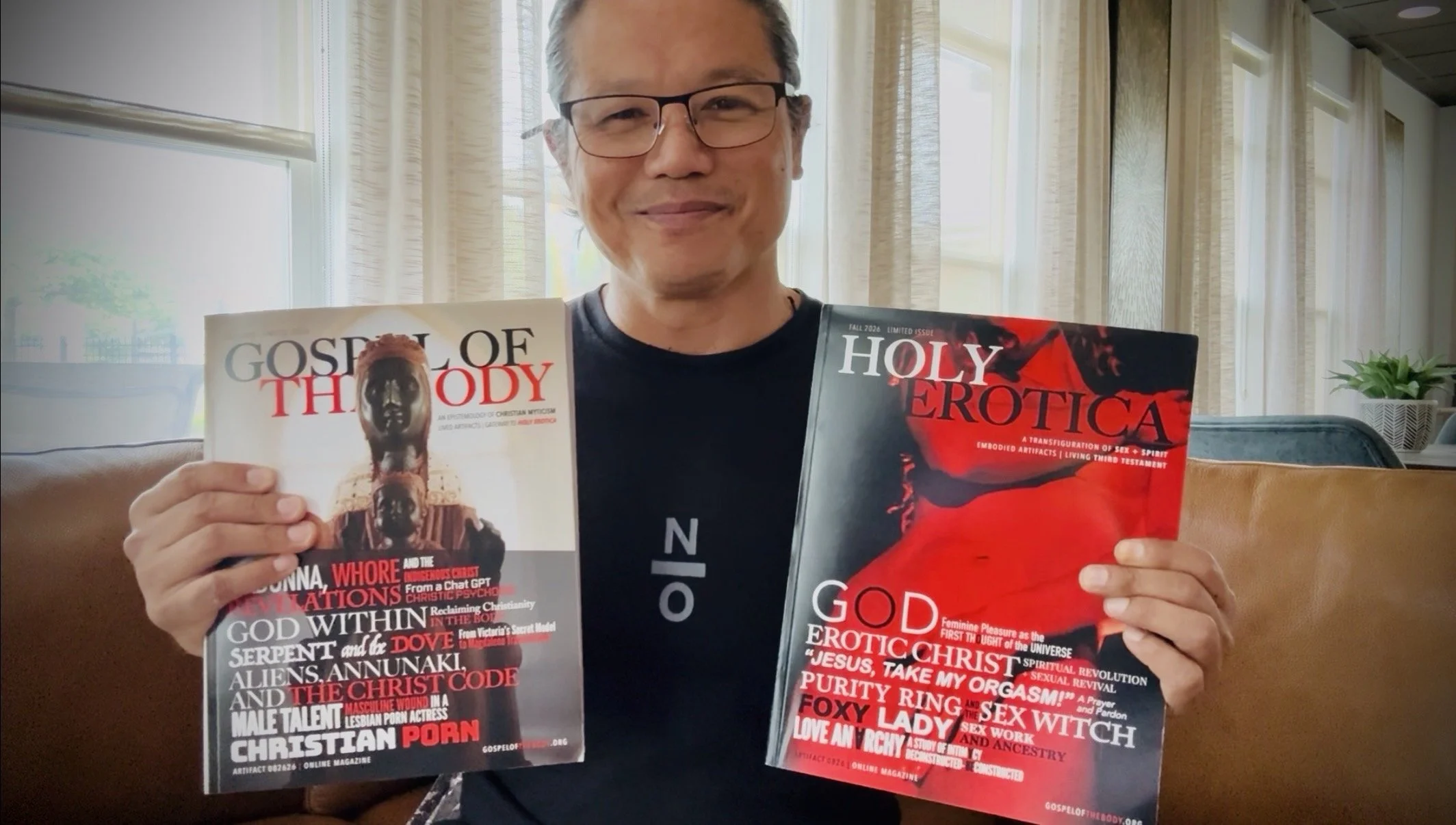
FOR A NATION IN THE MIDST OF SPIRITUAL-SEXUAL AWAKENING
-
FAITH, ESTRANGEMENT, AND LOVE
I’ve finally found a way to articulate why I’ve distanced myself from so many people.
For years, I’ve been trying to understand experiences that profoundly changed my relationship with God, Christ, and myself. What I experienced as an expansion of my faith has sometimes been interpreted by people I love as a departure from it. And that has broken my heart, but also, doesn’t surprise me.
I know how difficult it can be to hear something that challenges the theology we grew up with. As a Christian, I understand that instinct. I know how I might have reacted to someone describing the experiences I’ve had.
But I also know what happened to me. I know how deeply these experiences changed me, and I cannot simply return to the person I was before them.
My journey began my religoius-sexual wound and my investigation into purity culture, but it led me somewhere much larger: into questions about the body, cultural conditioning, colonialism, and the ways Christianity has sometimes been used to justify the violation of human dignity in the name of God, like the teaching of a Virgin Christ which I am both endeared too and critical of.
This is the inquiry behind Gospel of the Body.
I don’t expect everyone to agree with my conclusions or curiosities. I’m not asking anyone to abandon their faith or pretend to understand experiences they haven’t had. I’m asking for the possibility that we can listen to one another without immediately deciding that someone has lost their way. I ask this because this has been the type of person I’ve always been.
Because beneath all of this, I am still the same person who loves God, loves Christ, and loves the people who have been part of my life.
There are parts of me that have changed, yes. But there are parts of me that remain the same. Everything I know of Christ is still there. Everything I know of God is still there. I embrace my Christianity as much as I embrace my Arkansas and Filipino roots. This is my foundation, not as argument, but as fact. I love this as I love myself, as I also love my new self.
To summarize what I’ve experienced and learned in a commonsensical way that dignifies the theology I’ve grown up with, I’ll put it this way:There is simply more room than I originally thought. Not changed. Not erased. Not rebooted. Expanded. Love allows more room.
I’ve written the fuller story, including the experiences that brought me here and the questions I can no longer ignore. I’ve placed it on my website GospelOfTheBody.Org because I need a space where the entire story can exist, beyond the limits of a Facebook post.
If you want to understand more, you can read the rest there under the OPEN LETTER button.
OPEN LETTER PART 2:
THE EXPERIENCE THAT CHANGED MY FAITH
I began to examine the history of Christianity, including the ways religious authorities have interpreted scripture, marginalized alternative traditions, and participated in colonial systems; all through the lens of conquest and communion. What happens when the institution that claims to represent God becomes an instrument of conquest? What happens when a theology of purity makes people more concerned about sexual transgression than the violation of human beings? And what happens when the image of Christ becomes more important than the people Christ calls us to love?
SPIRITUAL RAPE
These are the questions behind my use of the phrase SPIRITUAL RAPE. I know the phrase SPIRITUAL RAPE is confronting and polarizing. Nonetheless, it is deliberate. I use it to infuse emotion in the nervous system where there is literally no emotion at all. I use it to describe the COGNITIVE DISSONANCE around the violation of human dignity, cultural memory, and spiritual sovereignty under the conquest authority of God or religion. This is where Christians have no feeling, no conviction, no sense of orientation. This is where Christians become lost. To me, I saw this as a concern to lean deeper into. For others, this may be a waste of effort and a toying with temptation.
NEUROPLASTICITY AND FAITH
What I am able to do now which I was not able to do as a traditional Christian is to point out the real science-based neuroplastic disconnect Christians have with the body. This is summarized as relating God and the body or relating spirituality with sexuality. It seems obvious to me that during a period of rape culture, this distinction is needed now more than ever. However, due to neuroplasticity, the Christian community seems to be the defenders of rape versus the accusers. If not directly in the form of endorsing rape, indirectly in the form of lacking an ability to call out, accuse, or shame rape. In fact, the Christian community shames those who calls out rape as being those who are attacking Christ despite being the ones who are speaking for Christ as the victim-exile.
THE MISSING LINK
As both Christian and non-Christian, I can see where the Christian reaction comes. By not having an erotic Christ and only a virgin Christ, there is a neuroplastic short circuitry that happens where a woman’s sexual sovereignty is interpreted as demonic and a man’s sexual entitlement is interpreted as Christ. We are missing a distinction, one where Christic sovereign eroticism is seen as love (not demonic) and that Christic sexual entitlement can be seen as demonic (not love).
When a community has taught us to understand God in one particular way, an experience that challenges that understanding can feel like a threat to God himself. I understand this because I was formed by Christianity. I know the comfort of belonging to a shared faith. I also know how difficult it can be to question something that has shaped your entire understanding of goodness, identity, and salvation. And I know that I could be conditioned too. I don’t consider myself beyond questioning or correction.
But I have become concerned about what happens when inherited theology is protected from examination while the suffering of actual human beings is minimized. We see this contradiction in the history of colonialism. We see it when survivors of sexual abuse are silenced or blamed. We see it when religious identity becomes more important than the dignity of the people around us. And I see it in contemporary America, where public attention can move rapidly from revelations about sexual abuse and the Epstein case toward other political crises, including war, while questions of accountability remain unresolved.
My concern isn’t that Christians should abandon Christ. It is that professing Christ should require us to look more honestly at the people who suffer, especially when suffering has been justified in his name. I keep returning to the same question: Can we recognize Christ in the people our inherited beliefs have taught us to overlook? Can we see Christ in the exile? Because that is where Christ is.
THE COST OF THE CALL
I wish I could say that finding these questions brought me immediate clarity, peace, and a better life. It didn’t. I had to test it. Quietly. Privately. Living it. Breathing it. Finding Christ and God in it again just as I recognized Christ and God before. I’ve been grieving relationships that changed, friendships that became distant, and the possibility that people I love may never understand what I’m trying to articulate. Even my relationship with money, success, and the life I thought I was supposed to build has changed. One of the hardest things has been trying to explain this to people who love me. So I simply didn’t. This open letter is my first attempt.
When I speak about sexuality, they may hear a rejection of Christianity. When I speak about the Virgin Christ, they may hear an attack on Jesus. When I speak about conquest, they may hear an accusation against every Christian. That isn’t the conversation I’m trying to have. But they are the words I am using. Because in reality, no one faith or one person has sole claim over these words. Just because I couldn’t use Christ and erotic together in my earlier life, does this mean I shouldn’t use these words together when I can combine them in my current life? Especially when juxtaposing Erotic Christ together nourishes and inspires me? Especially when it reveals what I believe is the missing link that enables Christianity to see the conquest-rape in its wake.
Who I embody now is simply a different me, a different frequency, and yes, perhaps a different Christ. But please understand, for me, this is not embodying an anti-Christ, but the same Christ that can paradoxically hold more beyond my neuroplastic threshold—both Christ and anti-Christ as the light and shadow of the yin-yang, reconciled and made whole. Now I am examining the difference between a conquest-conditioned Christ of PURITY and a communion-embodied Christ of PARADOX: one is divide and conquer (or convert), the other is dignifying to both.
Recently, I shared my story with a friend. He told me it was a lot to take in. I understood. I told him he didn’t have to read everything or respond immediately. I told him that I loved him and didn’t want to lose him. I also acknowledged that we might understand faith differently, and that our love for each other and for God might not be enough to resolve every disagreement. But I hope there is another possibility. That we can still be brothers in paradox. I don’t want my friend to become my enemy. I don’t want to make an enemy of him, either. I want there to be enough room for both of us.
WHY I MADE GOSPEL OF THE BODY AND HOLY EROTICA
This is why I made Gospel of the Body and Holy Erotica. I needed somewhere to put the whole experience: the mystical encounters, my history with Christianity, my questions about sexuality, the cultural inheritance I had overlooked, and the historical contradictions I had begun to investigate. The life I chose to live quietly to protect friends and family I love is now made public as artifact curation and as a trail of breadcrumbs for those who recognize themselves in it. The magazine is an attempt to bring those pieces together. It is part personal testimony, part cultural inquiry, part theological investigation, and part artistic curation. I’m not asking readers to accept every interpretation I offer. I’m asking them to enter the inquiry and share presence with one another; in the spirit of communion and expansion.
For me, this is not about abandoning Christianity. It is about asking whether our understanding of Christ can expand enough to confront the ways Christianity has been used to shame bodies, erase cultures, and justify conquest; to own the anti-Christ of conquest Christianity just as I have acknowledged my dualistic parts. I know some people will disagree with me. Some may believe my experiences are incompatible with their understanding of Christian faith. I cannot control that. What I hope is that disagreement doesn’t have to become dehumanization, and that uncertainty doesn’t have to become estrangement. That despite these differences, we can love and dignify God in the other. This is the experience of God.
I am still learning. I am still questioning. I am still trying to understand what happened to me and what I should do with it. And I am still trying to love the people who cannot yet understand it. Everything I know of Christ is still there. Everything I know of God is still there. There is simply more room than I originally thought. Not changed. Not erased. Not rebooted. Expanded.
Love allows more room. It’s as simple as that.
-Nathanael L. Novero
To understand why I’ve arrived here, I need to explain what happened. My journey began with an experience I believe was the embodied Holy Spirit of Pentecost.
Saint Teresa of Ávila described a similar mystical experience in her writings, an event later depicted by Christian mystic sculpture Bernini in The Ecstasy of Saint Teresa in the Cornaro Chapel of the church of Santa Maria della Vittoria in Rome. This sculpture is based on St. Terersa’s writings of an erotic encounter with God; an angel piercing her heart with a spear, a somatic memory of both pleasure and pain. I’ve associated this experience with a term first referenced by English Jesuit priest Henry James Coleridge in 1881, transverberation a rare form of embodied religious ecstasy.
I use the language of transverberation because it gives me a point of reference for something I struggled to articulate. I’m not claiming that my experience was identical to hers. I’m saying that her account helped me find language for what I experienced in my own body.
Of course, traditional Christians have been taught to distrust the body, a belief reinforced for millennia resulting to a collective neural plasticity that has no shelf to hold this experience without first demonizing it as Satanic or demonic. I understand this belief and, surprisingly even for me, support this conclusion. However, I also want to add the reality of neural plasticity and its role in regards to what we experience as real.
How much of our faith is faith and how much of our faith is neural plastic conditioning? That is the question. This is the inquiry I hope my story fans into flame because it’s an important one. At what point is Christianity a movement of God and at what point is it a conquest conditioning of empire? It is my belief that these questions always lead us to greater and safer insight. I do not see this as a threat to Christ but as a liberation.
MAKE HOLY EROTICA
My mystical experience was shared with a woman who is a therapist and a survivor of child sex trafficking. During our kundalini awakening, I received the words: “Make Holy Erotica.” I also experienced a shared vision of Mary Magdalene leading a first church of women in a cave. These were women healing from sexual abuse. There was no literal voice speaking aloud. Instead, there was a somatic recognition throughout my body, a sense of knowing that God had already spoken. It was the understanding of God’s voice rather than the sound of one.
I know that describing an experience this way may be difficult for someone else to understand. I know that someone can question whether it was God, my own consciousness, or something I have yet to understand. But the experience itself was real to me, and it became a turning point in my life. This was also an encounter that was shared, in-part, with a friend and colleague.
To be clear, I did not interpret this experience as a rejection of Christ. I experienced it as an encounter with the same Christ who had saved me. That distinction matters because so much of what followed has been interpreted through the assumption that an experience involving sexuality must be incompatible with God. On the contrary, through my embodied experience, it is in communion with God.
ARK OF THE COVENANT
About a year later, while filming Holy Erotica, I experienced something else. I felt what I understood as the Ark of the Covenant within my body: the presence of God embodied within me. I was filming a sexual encounter between two women who were not married. Within the Christian framework I had inherited, the act could be classified as fornication. But my experience produced a different theological and somatic memory. God was present, as blessing, as holy ground.
This changed everything for me. What if sexuality itself was never the sin? What if the shame attached to it, as a conditioning, was the sin? I’m not suggesting that every sexual act is sacred simply because it is sexual. Consent, dignity, care, and the sovereignty of the people involved matter. I’m asking whether sexuality has been so thoroughly associated with sin in some Christian traditions that we have lost the ability to examine the body and sex without shame. If so, this is a serious problem that prevents us from seeing and experience the holiness in it.
I had spent years inside a religious culture that taught me to separate the sacred from the sexual. Yet I was experiencing something sacred in what should have been sin, love in the presence of broken law, and I recognized this as God. I had to investigate it. And that investigation became Holy Erotica.
FROM SEXUALITY TO CONQUEST
Sex was my entry point. But it wasn’t the end of the inquiry. The deeper question was about conquest and communion.
I began examining the relationship between sexual shame, religious authority, colonialism, and the erasure of Indigenous cultures. I started asking how Christianity could teach the love of Christ while also being used to justify the violation of people in his name.
How could the Virgin Christ seem more sacred than the bodies of rape victims? How could the image of Jesus be cherished while Indigenous people were dispossessed, their traditions suppressed, and their histories erased by people who claimed to represent him? How could a nation profess Christianity while failing to recognize the dignity of those it had conquered? These questions became personal which resulted to the discovery of my own identity.
I’m Filipino American. Yet I recognized how much more passionately I had identified with American Christianity than with my Filipino heritage. How much of this was conditioning? How much of this was conviction? These questions forced me to look at the cultural conditioning I had inherited in the Bible Belt. What had I learned to value? What had I learned to reject? What parts of myself had I been taught to overlook in order to belong? I began to see that sexuality was not the only place where shame and conditioning operated. Culture, identity, and spirituality were involved too. My entry point was sexual, but the questions became cultural and historical.
I began to wonder whether the religious conditioning surrounding purity could participate in a broader pattern: the separation of people from their bodies, their ancestral memories, and their own sense of sovereignty for a greater mission of conquest. I began to see a connection between the treatment of the body and the treatment of Indigenous peoples. Instead of seeing my own religious-sexual wound, I began to see the world’s religious-sexual wound, but not as accident, as something deliberate and nefarious. Like rape.
THE VIRGIN CHRIST, THE EROTIC CHRIST
This is where my theological inquiry became more difficult to explain. I began using the terms Virgin Christ, Erotic Christ, Conquest, and Communion to articulate the contradictions I was seeing. These are the interpretive distinctions through which I now explore my experiences. They are not claims that every Christian understands. Now now. But I believe every Christian is starting to, beginning with America’s inability to persecute players of the Epstein Files and accounts of child rape and human trafficking.
For me, the Virgin Christ represents a religious framework in which purity can become associated with disembodiment, sexual shame, and the policing of the body. I began asking how that framework might be used to reinforce systems of domination. The Erotic Christ represents a different possibility: a Christ encountered through embodiment, sovereignty, communion, and the restoration of dignity.
Erotic, as I use the word, does not simply mean genital sexuality. It points toward sovereignty. Conquest is the taking of another person’s sovereignty. Communion is the recognition of sovereignty in oneself and in another. Conquest says that another person’s body, land, culture, or life can be claimed in the name of a higher authority. Communion asks whether love can exist without taking possession. This distinction has become central to Gospel of the Body.

© 2 Stories / Nathanael L. Novero, 2025. All rights reserved.
All content on this website, including text, images, graphics, videos, and design elements, is the exclusive property of 2 Stories / Nathanael L. Novero or permission has been given.
Reproduction, distribution, modification, or any unauthorized use of the content is strictly prohibited without explicit written permission. For inquiries regarding permissions, please contact: NathanaelNovero@gmail.com